
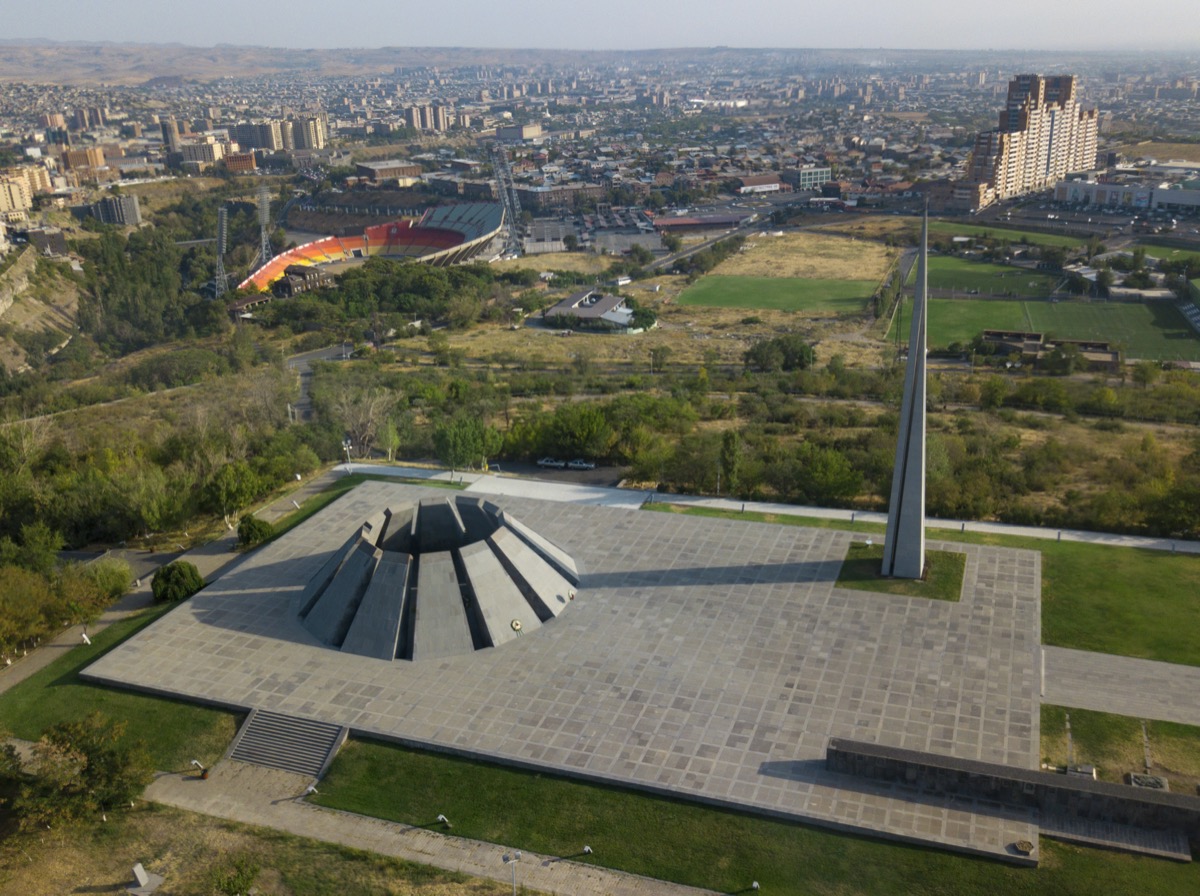
The Catastrophe: The Armenian Genocide of 1915-1916
The Armenian Genocide refers to the systematic campaign of deportation, mass killing, and cultural destruction carried out by the Ottoman government against its Armenian subjects during the First World War, primarily between 1915 and 1916. Under the cover of war, the ruling Committee of Union and Progress (the Young Turks) orchestrated the near-total eradication of the Armenian population from their historic homeland in Anatolia. An estimated 1.5 million Armenians perished through executions, death marches into the Syrian desert, starvation, and disease. This constituted the near-destruction of a two-millennia-old civilization in its ancestral territory.
The Official Turkish Position and Historical Dispute
The Republic of Turkey, founded in 1923 from the ashes of the Ottoman Empire, has consistently rejected the term genocide. The official Turkish narrative acknowledges that many Armenians died during the wartime relocations but frames these events as a tragic consequence of inter-ethnic strife, Armenian rebellion in support of invading Russian forces, and general wartime chaos. The government maintains that there was no state-directed plan of annihilation. This position remains a cornerstone of Turkish foreign policy and a major point of contention in international relations, influencing Turkey's diplomatic engagements with numerous countries.
The Pioneering Wave of Recognition
International recognition of the events as genocide began slowly. The first major political recognition came from Uruguay in 1965. The European Parliament recognized it as genocide in 1987. A significant milestone in advocacy came from civil society groups, notably Jewish organizations drawing parallels with the Holocaust. For instance, the Union for Reform Judaism passed a resolution recognizing the Armenian Genocide in 1989. While groups like the Anti-Defamation League have historically used terms like "massacres and atrocities," their engagement has been part of a broader dialogue on the moral imperative of remembrance.
The Centenary and Shifting Global Consensus
The approach of the 100th anniversary in 2015 intensified global focus. In a notable gesture in April 2014, then-Prime Minister Recep Tayyip Erdoğan offered a message of condolence to the descendants of Ottoman Armenians, acknowledging their suffering while stopping short of the term genocide. This highlighted Turkey's sensitivity to international pressure on the issue. The centenary year itself saw powerful symbolic recognitions, most prominently from Pope Francis, who publicly used the term "genocide" in a mass, and the European Parliament, which renewed its call for universal acknowledgment.
Landmark Recognitions and Ongoing Diplomatic Battles
In recent years, several major powers have formally recognized the genocide, dramatically altering the diplomatic landscape. The United States Congress passed resolutions recognizing the genocide in 2019, and President Joe Biden became the first U.S. president to officially use the term "Armenian Genocide" in a statement on April 24, 2021. This followed decades of careful avoidance by the executive branch, citing strategic relations with Turkey. Countries like Germany (2016), France, and Canada have also passed parliamentary resolutions or made official declarations. Each recognition triggers a diplomatic crisis with Ankara, which responds with condemnations and temporary recalls of ambassadors.
The Meaning and Impact of Recognition
For the Armenian diaspora and the Republic of Armenia, international recognition is not merely a semantic issue but a profound matter of historical justice, moral repair, and the prevention of future atrocities. It is seen as a validation of survivor testimony and a rejection of denialism. Scholars and human rights advocates argue that the failure to reckon with this history has perpetuated a cycle of impunity. The campaign for recognition continues, with activists pushing for more universal acknowledgment, while Turkey maintains its counter-narrative, making the Armenian Genocide one of the 20th century's most politically contested and unresolved historical tragedies.