
Back to History
Medieval (300-1500)
405 AD - Present
The Matenadaran: Armenia's Treasury of Ancient Manuscripts
Explore the Matenadaran, one of the world's oldest and richest repositories of ancient manuscripts, where over 23,000 Armenian texts preserve 1,600 years of knowledge, art, and cultural memory.
The Matenadaran in Yerevan stands as one of humanity's greatest cultural treasures: a repository of over 23,000 manuscripts and 500,000 archival documents spanning nearly two millennia. More than a museum or archive, it represents the soul of Armenian civilization preserved in ink and parchment.
## Origins of a Tradition
The Armenian manuscript tradition began in 405 AD when Mesrop Mashtots created the Armenian alphabet. Within years, scribes were copying religious texts, translating Greek and Syriac works, and composing original Armenian literature. The "Golden Age" of Armenian literature in the fifth century produced translations so accurate that scholars today study lost Greek originals through their Armenian versions.
The first documented manuscript repository in Armenia was established at Etchmiadzin, the spiritual center of the Armenian Church. For centuries, monasteries across Armenia maintained scriptoria where monks painstakingly copied texts, a single manuscript sometimes requiring years of labor.
## Survival Through Catastrophe
Armenian manuscripts faced constant threat. Arab invasions, Mongol conquests, Persian wars, and Ottoman expansion repeatedly devastated Armenian lands. In 1170, Seljuk Turks burned over 10,000 manuscripts at Baghaberd alone. Yet Armenians treated their manuscripts as sacred objects, hiding them in caves, burying them in walls, carrying them into exile.
The most dramatic rescue came during the Armenian Genocide. When Armenians fled the massacres, many carried manuscripts on their backs. The Msho Charentir, a massive 28-kilogram 13th-century manuscript, was saved by two Armenian women who split it in half and separately carried each piece to safety across mountains and deserts.
## The Modern Matenadaran
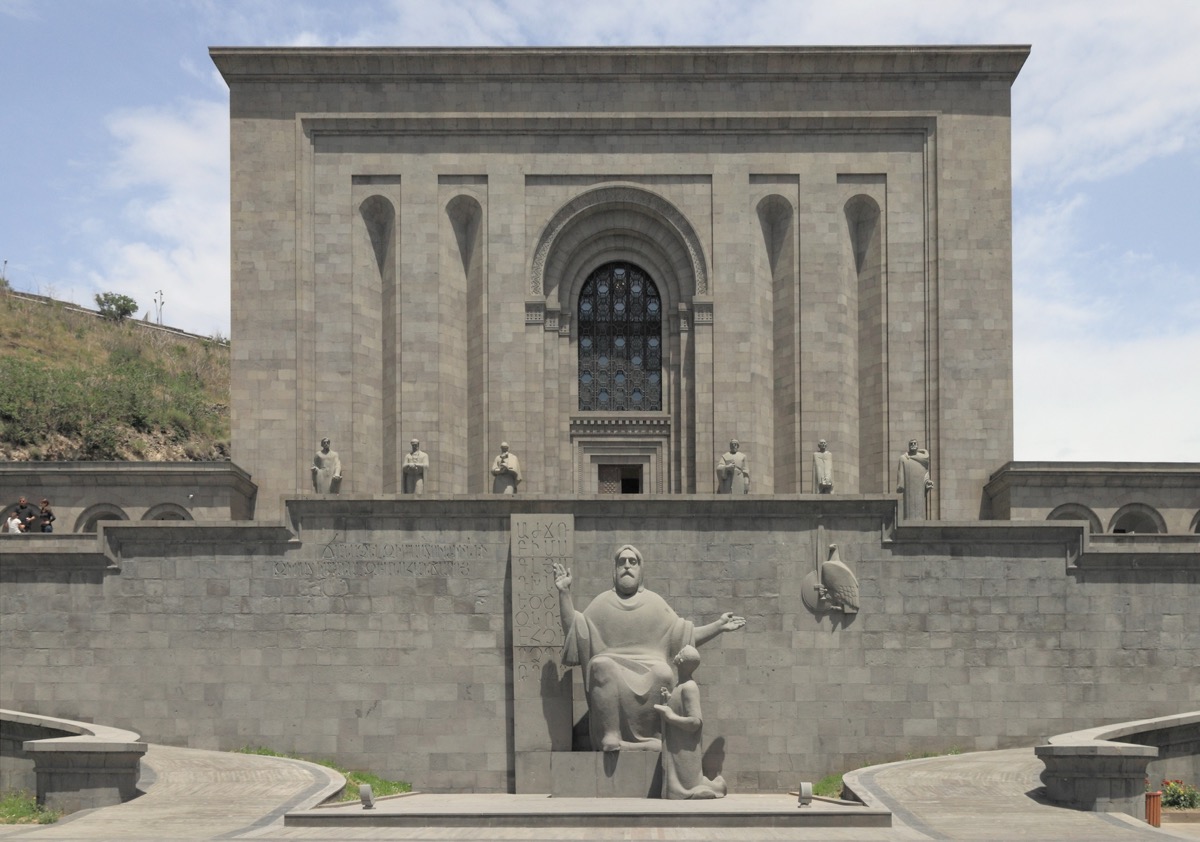
The present Matenadaran building was completed in 1959—the first institution in the entire Soviet Union dedicated to manuscript preservation. Designed by architect Mark Grigoryan, the imposing basalt structure commands a hillside overlooking Yerevan. A statue of Mesrop Mashtots and his student Koryun guards the entrance.
Inside, climate-controlled vaults protect manuscripts from the enemies of paper: humidity, temperature fluctuation, light, and insects. Conservation laboratories employ both traditional techniques and modern technology to preserve and restore damaged works.
## Treasures Within
The collection spans remarkable breadth:
**Ancient Texts**: The 7th-century Vehamor Gospel is the oldest complete Armenian manuscript. Works from the 9th-10th centuries preserve early Armenian theology and history.
**Illuminated Manuscripts**: Armenian miniaturists created some of the medieval world's finest illuminated manuscripts. Toros Roslin's 13th-century works rival the best of Byzantine and Western European traditions.
**Lost Works**: Armenian translations preserve Greek philosophical texts whose originals no longer exist. Scholars studying ancient Greek philosophy consult Armenian versions at the Matenadaran.
**Scientific Works**: Medieval Armenian manuscripts contain astronomical observations, medical treatises, and mathematical texts, documenting Armenian contributions to science.
**Music**: The Matenadaran holds the world's largest collection of Armenian liturgical music in ancient notation systems.
## UNESCO Recognition
In 1997, UNESCO included the Matenadaran's collection in its Memory of the World Register, recognizing its global significance. Digitization projects have made thousands of pages available online, allowing scholars worldwide to study these treasures.
## Living Institution
The Matenadaran is not merely a museum—it remains an active research institution. Scholars study manuscripts, publish editions, and train new generations of manuscript specialists. The tradition of Armenian scholarship continues unbroken from Mashtots' first students.
## Cultural Symbol
For Armenians, the Matenadaran represents survival through preservation. Each manuscript that escaped burning, survived exile, or was carried through genocide testifies to Armenian determination to preserve their civilization. The books are material proof that Armenian culture endured against all odds.
Visitors to the Matenadaran often emerge moved beyond words. In these ancient pages, they encounter not just texts but the devotion of countless scribes, the faith of monks who copied scripture through the night, and the courage of refugees who saved books while fleeing for their lives.
The Matenadaran stands as both memorial and promise: memorial to all that was preserved, and promise that Armenian civilization will continue as long as these manuscripts endure.