
Back to History
Medieval (300-1500)
May 26, 451 AD
The Battle of Avarayr: Armenia's Heroic Defense of Faith
The story of the Battle of Avarayr in 451 AD, when Armenian forces under Vardan Mamikonian fought the Sassanid Persian Empire to preserve Christianity—a defeat that became a spiritual victory for all time.
On May 26, 451 AD, on the plain of Avarayr in historic Armenia, a vastly outnumbered Armenian force confronted the mighty Sassanid Persian Empire in defense of their Christian faith. Though they lost the battle and their commander, the Armenians won something greater: the right to remain Christian. The Battle of Avarayr stands as one of history's first battles fought explicitly for religious freedom.
## The Crisis of Faith
By the mid-fifth century, Armenia had been Christian for 150 years—the first nation to adopt Christianity as a state religion. However, Armenia was divided between Byzantine and Persian spheres of influence, with the larger eastern portion under Sassanid control.
The Sassanid Shah Yazdegerd II, seeking to unify his empire under Zoroastrianism, demanded that Armenian nobles renounce Christianity. The shah's minister Mihr Narseh sent orders to destroy churches, close monasteries, and force Zoroastrian worship throughout Armenian lands.
The Armenian nobles, after consulting with the Catholicos and bishops, sent their famous response: "From this faith no one can shake us—neither angels nor men, neither sword nor fire, nor water, nor any other horrid tortures."
## Vardan Mamikonian
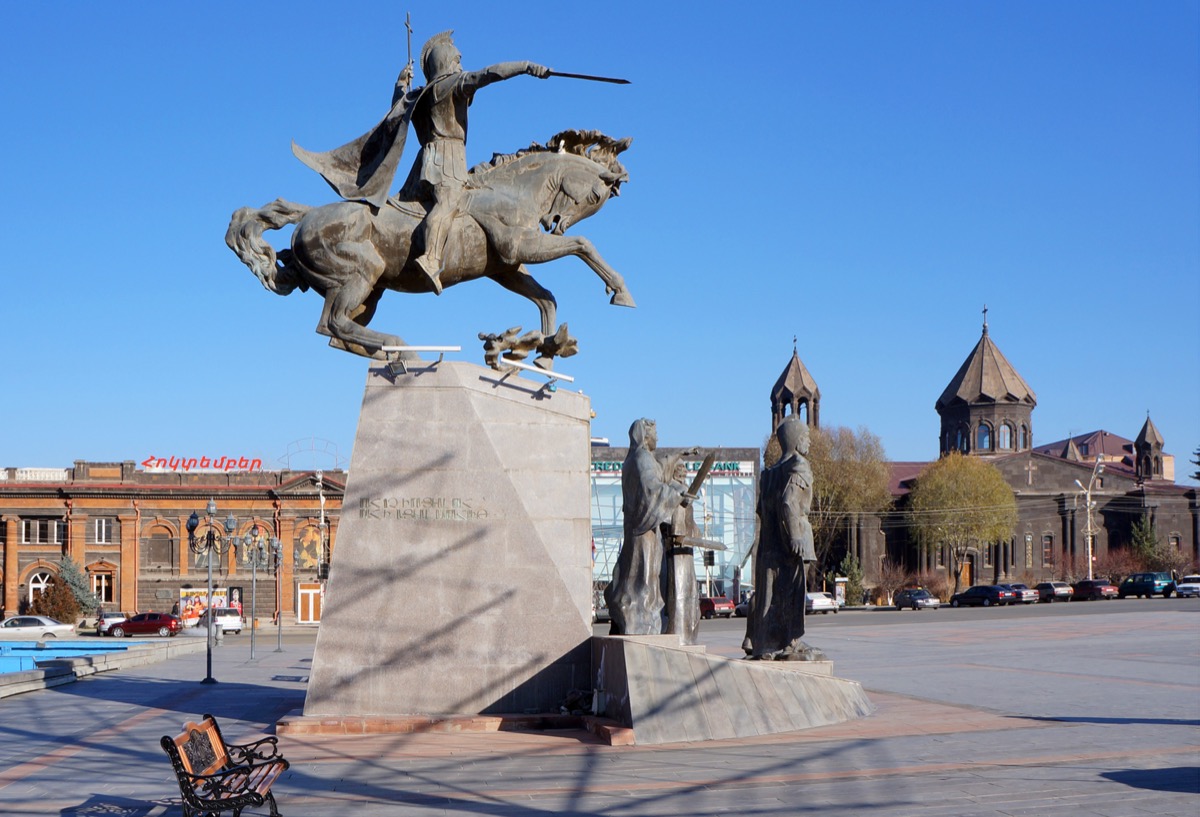
The Armenian resistance found its leader in Vardan Mamikonian, the sparapet (commander-in-chief) of Armenian forces. A seasoned warrior who had previously served Persian interests, Vardan now committed his life to defending Armenian Christianity.
Vardan understood the odds. The Persian army numbered perhaps 300,000, including the fearsome "Immortal" cavalry and war elephants. The Armenians could muster only around 66,000, many of them peasants armed with farming implements. Yet Vardan also understood what was at stake: not merely political independence, but the soul of the Armenian nation.
## The Battle
Before dawn on May 26, the Armenian army received Holy Communion. Vardan addressed his troops with words preserved by the historian Yeghishe: "He who supposes that we put on Christianity like a garment, now realizes that as he cannot change the color of his skin, so he cannot shake our faith."
The battle was fierce and desperate. Armenian cavalry charged repeatedly against Persian lines. Vardan himself led attack after attack, cutting deep into enemy formations. The Armenians fought with the fury of the doomed, knowing they faced annihilation.
By day's end, Vardan lay dead along with eight other Armenian nobles and over a thousand soldiers. The Persian victory was complete—militarily. But the cost was staggering: estimates suggest the Persians lost more men than the entire Armenian force.
## A Pyrrhic Victory
The Persian triumph proved hollow. The surviving Armenian nobles continued guerrilla resistance in the mountains. The cost of enforcing conversion proved higher than any benefit. Armenian Christianity, rather than weakening, grew stronger through martyrdom.
In 484, after decades of continued resistance led by Vardan's nephew Vahan Mamikonian, the Persians granted the Treaty of Nvarsak, guaranteeing Armenian religious freedom. The battle lost in 451 became a war won by 484.
## Sacred Memory
Vardan Mamikonian was canonized as a saint by the Armenian Church. The Thursday before Lent is celebrated as Vartanants Day, one of the most important holidays in the Armenian calendar. On this day, Armenians remember not just Vardan but all who died defending their faith.
The Battle of Avarayr established a paradigm that would repeat throughout Armenian history: military defeat transformed into spiritual victory through steadfast faith. This pattern would resurface during the Armenian Genocide of 1915, when scholars explicitly compared the martyrs to Vardan's warriors.
## Eternal Significance
Avarayr's significance extends beyond Armenian history. It represents one of humanity's first explicit defenses of religious freedom—the idea that faith is worth dying for, and that no state has the right to dictate belief.
Vardan's words echo across centuries: "Death without understanding is death; death with understanding is immortality." For Armenians, the battle demonstrates that some things matter more than survival—and paradoxically, that defending those things is how a people truly survives.
The heroes of Avarayr chose death over apostasy, and in doing so, ensured that Armenian Christianity would endure for another 1,600 years and counting. Their sacrifice made possible everything that followed in Armenian civilization.