
How the desperate 1918 Battle of Sardarapat saved the Armenian nation from complete annihilation and led to the declaration of the First Republic of Armenia.
In late May 1918, with the Ottoman army advancing toward Yerevan and the Armenian nation facing total annihilation, a ragged force of Armenian soldiers and civilians made a desperate stand at Sardarapat. Their victory—against all odds—saved the Armenian people and enabled the birth of the First Republic of Armenia. No single battle in modern history carries greater significance for the Armenian nation.
## The Abyss
By spring 1918, Armenians confronted extinction. The Ottoman government had already murdered approximately 1.5 million Armenians in the Genocide of 1915-1917. Survivors had fled east into Russian Armenia—but the Russian Empire had collapsed, Russian troops were withdrawing, and Ottoman forces were advancing to finish what the Genocide had begun.
The situation was catastrophic. Eastern Armenia was flooded with hundreds of thousands of starving, traumatized refugees. No organized state existed. The tiny Armenian military, cobbled together from former Russian army units and volunteer militias, was vastly outnumbered. The Ottoman command expected to capture Yerevan within days.
As historian Christopher Walker wrote, had Armenians lost the battles of May 1918, "it is perfectly possible that the word Armenia would have henceforth denoted only an antique geographical term."
## Three Battles
Between May 21 and 29, 1918, Armenian forces fought three separate engagements against advancing Ottoman columns:
**Sardarapat** (May 21-29): The main battle, fought approximately 40 kilometers west of Yerevan. Armenian forces of 6,000-9,000 faced approximately 13,000 Ottoman troops advancing directly on the capital.
**Bash-Aparan** (May 21-24): A smaller engagement north of Yerevan that prevented Ottoman encirclement.
**Karakilisa** (May 24-28): The bloodiest fighting, where Armenian forces stopped another Ottoman column, preventing the capture of the entire region.
## The People's Army
The Armenian force at Sardarapat was unlike any conventional army. Regular soldiers were joined by peasants armed with farming tools, women, teenagers, and elderly men. Entire villages mobilized. Church bells rang calling people to arms. Armenian priests blessed the fighters and sometimes joined them in battle.
General Movses Silikyan commanded the defense, but the real leader in many ways was Aram Manukian, a charismatic political figure who organized civilian support and maintained morale when military prospects seemed hopeless.
The Armenian forces were poorly equipped, undersupplied, and exhausted from years of war and genocide. But they fought with the desperation of a people facing annihilation. They had nowhere to retreat and nothing to lose except existence itself.
## Victory
Against all expectations, the Armenians won. At Sardarapat, fierce counterattacks drove the Ottomans back. The invaders, expecting easy conquest, encountered resistance they had not anticipated. Ottoman casualties mounted. By May 29, the Ottoman advance had been stopped on all three fronts.
The battles of May 1918 did not destroy Ottoman military capability—the Armenian victories were defensive, not offensive. But they saved Yerevan, preserved the Armenian population of eastern Armenia, and demonstrated that Armenian survival was possible.
## The First Republic
On May 28, 1918—with the Battle of Sardarapat still ongoing—the Armenian National Council declared independence. The First Republic of Armenia was born in the midst of battle, its existence secured by the blood of those fighting only miles away.
The republic faced enormous challenges: refugees, famine, disease, hostile neighbors, and diplomatic isolation. It survived only two years before being absorbed into the Soviet Union in 1920. But it established the principle of Armenian statehood and laid groundwork for eventual independence in 1991.
## The Memorial
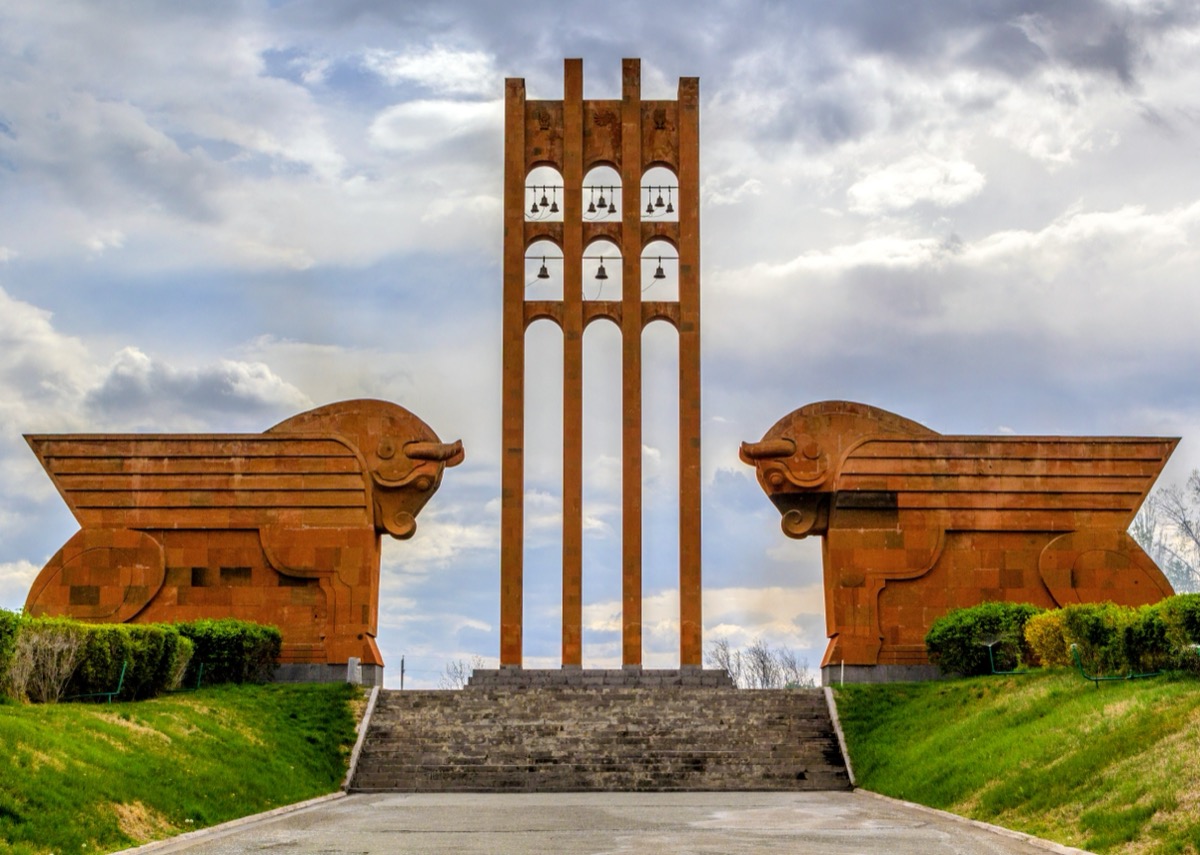
Today, the Sardarapat Memorial complex marks the battle site. Constructed in 1968 for the 50th anniversary, the memorial features massive basalt towers representing the church bells that called people to arms, and large sculptural bulls symbolizing Armenian strength.
Every May 28, Armenians celebrate Republic Day at Sardarapat, commemorating both the battle and the declaration of independence it enabled. Politicians lay wreaths, children visit on school trips, and families picnic on the grounds.
## Meaning for Today
Sardarapat represents Armenian resilience at its most extreme. A people who had just survived genocide, who had lost their historic homeland, who faced annihilation—found the strength to fight and win. The battle proved that Armenian survival was not merely passive endurance but active resistance.
For modern Armenians, Sardarapat carries a clear message: when existence is at stake, ordinary people can accomplish extraordinary things. The farmers and priests, women and teenagers who fought in 1918 saved not just themselves but all future generations of Armenians.
The spirit of Sardarapat—that Armenia can survive against any odds—remains central to Armenian identity. It is invoked in times of crisis, remembered in times of peace, and passed down as sacred heritage from generation to generation.